Showing posts with label King David. Show all posts

Friday, March 14, 2014

Lent Day 9: Knowing and being known

A repost of a blog I wrote in 2012, with a comment included below. Enjoy.

"Why was David a man after God's own heart?" someone asks. Perhaps because he did not run ahead? Knowing he was to be king, he spared his predecessor twice––during manhunts for his own life.

A group of us circled a beautifully appointed living room last night (thanks, Paul and Bev). Once a month we meet to study Bible characters. Each one exposes God and humanity = God's interaction with us in community and as individuals. Yesterday, David came under the magnifying glass.

We read scripture passages aloud and then discuss the nature of God, the nature of humans, and our response to God within the joys and challenges of our own humanity. On the way home, W and I talked about what we had learned.
  • My personal takeaway? Creating opportunity for others to understand God's truths makes me happier than when I learn things myself. Clear as a bell, my heart rang out with the pure joy and energy of leading a group. 
  • Training and teaching others feels like finding a puzzle piece or watching internal gears click into place. A sense of ease and comfort comes from facilitating the exploration and application of scripture. This is not something I struggle to learn or do but who I am. I'm surprised by sheer happiness every time I speak in public.
  • What we learned about Samuel and David? Samuel, the veteran leader and intercessor of Israel, was stuck. The worst thing had happened to his successor: Saul was a dud. Yet God was ready to move on and provided Samuel with the satisfaction of anointing the next generation.
  • David had tremendous self-confidence because he knew his God and himself. He was comfortable in the gifts God gave him, a love of music, the ability to strategize, the confidence to run toward a giant who was defying God's name. When given an opportunity, David seized it and did the job with gusto (unlike Saul whose lack of self-confidence never matched up to his kingly appearance.)
  • David did menial jobs with enthusiasm and never pushed himself into the foreground. Knowing he would be king and having accomplished champion feats, David willingly stood in the background of the palace, playing music and lugging armor while Saul ruled. (I wonder how many of David's ideas for sound monarchy came from observation: "Wow, good plan there!" or the contrast: "Saul, what are you thinking!? This is a bad idea." 1 Samuel 16)
  • As the youngest brother, he got no respect from his dad, who didn't even call him to dinner with Samuel. (Read the full story below.) His older siblings discounted him––even after they had watched Samuel anoint David for kingship (shades of Joseph?) David's feisty response of "What have I done wrong now?!" possibly exposes a pattern of family put-downs and "Go away, little brother, you don't know anything." (1 Samuel 17)
  • David used his own gifts, training, and experiences rather than relying on the proven armor and battle plans of others. He laid aside the burden of Saul's armor (though he had been an armor bearer for the king and probably knew it well) for smooth stones and a stick, tools he felt comfortable with.
  • David pinpointed the heart of the issue rather than looking at circumstances. He recognized Goliath as God's enemy, not as a human giant or seasoned opponent and dealt with him on that basis. The fight as well as the victory belonged to God. However, David did not let go of Goliath's severed head until he was taken to the king as proof of his accomplishment. Hmmm.
  • David had many opportunities to make God's plans come true but he was unwilling to act beyond what he knew of God's character. Because of this, he and those allied with him suffered while: 1. others got credit and lived in the inner circle; 2. David was hunted like an animal and led a rabble pack of raiders; and 3. he absolutely rejected chances to seize power through "divine appointments," even when prompted by others.
Maybe David's patient humility, decidedly unusual among those in power or the ambitious, endeared him to God. Though David committed adultery, murder, and disobeyed God in many ways, God saw a heart that longed for obedience and surrender.

When Samuel came to anoint one of Jesse's sons as future king, he noted that God looked on the inner person rather than the outward appearance. David's quest to please God and his willingness to let God work out the details in God's time set him head and shoulders above seven brothers. It made the shepherd "of a few sheep" (according to a snide remark from his brother) an amazing leader of a nation.

I'm ending a season of study. I get many suggestions of what I could do and where God might be leading me. The study of David reinforced my caution against moving forward and making things happen. I'm going to wait for God's go-ahead and a clear call to action. [A year after this was written in 2012, we committed to moving to Indonesia permanently. The PhD in Intercultural Studies that I was working on will certainly come in handy, though I didn't know it at the time. It's worth waiting for God's timing. RK]

Oh God, may we seek and obey you with the humble confidence that knows you are pleased with how you made us and have a place for us. You are able to use us without our "help" in pushing others aside, propelling ourselves forward, or boasting about our accomplishments. 

Make us beautiful inside so that your Spirit can direct us in life's menial and circuitous paths as needed, whether kingship or sheep herder is our destiny. Amen.

Read more:
*The LORD said to Samuel, “How long will you mourn for Saul, since I have rejected him as king over Israel? Fill your horn with oil and be on your way; I am sending you to Jesse of Bethlehem. I have chosen one of his sons to be king.”

But Samuel said, “How can I go? If Saul hears about it, he will kill me.”

The LORD said, “Take a heifer with you and say, ‘I have come to sacrifice to the LORD.’3 Invite Jesse to the sacrifice, and I will show you what to do. You are to anoint for me the one I indicate.”

Samuel did what the LORD said. When he arrived at Bethlehem, the elders of the town trembled when they met him. They asked, “Do you come in peace?”Samuel replied, “Yes, in peace; I have come to sacrifice to the LORD. Consecrate yourselves and come to the sacrifice with me.”

Then he consecrated Jesse and his sons and invited them to the sacrifice. When they arrived, Samuel saw Eliab and thought, “Surely the LORD’s anointed stands here before the LORD.”

But the LORD said to Samuel, “Do not consider his appearance or his height, for I have rejected him. The LORD does not look at the things people look at. People look at the outward appearance, but the LORD looks at the heart.”

Then Jesse called Abinadab and had him pass in front of Samuel. But Samuel said, “The LORD has not chosen this one either.” Jesse then had Shammah pass by, but Samuel said, “Nor has the LORD chosen this one.” Jesse had seven of his sons pass before Samuel, but Samuel said to him, “The LORD has not chosen these.” So he asked Jesse, “Are these all the sons you have?”

“There is still the youngest,” Jesse answered. “He is tending the sheep.”

Samuel said, “Send for him; we will not sit down until he arrives.” So he sent for him and had him brought in. He was glowing with health and had a fine appearance and handsome features.

Then the LORD said, “Rise and anoint him; this is the one.” So Samuel took the horn of oil and anointed him in the presence of his brothers, and from that day on the Spirit of the LORD came powerfully upon David. 1 Samuel 16

*Read more about David in 1 Samuel 17 through 2 Samuel 2.

Tuesday, May 29, 2012

Holy Land Day 18: May 27 Hello to Samson, David, and Judas Maccabee

Psalm of Ascent #131.

My "Bedouin-crafted" quilt, purchased yesterday
in the Old City. Note the central bodice and the size
of the  flip-flop placed for scale. The colored
border is between lime and olive, to give you
an idea of the true colors.
Bright, wonderful, sparkly, and delightful.
When we leave the hotel at 8am, Jewish people are streaming from the synagogues after studying Torah overnight for Shavuot (Feast of Weeks, parallels the Christian Pentecost). Shavuot celebrates the giving of the oral and written Torah on Mt. Sinai. Speaking in tongues during Pentecost (Acts 2) has close parallels to the giving of the Torah, according to Ilan.

Jews celebrate three main feasts that are considered times for pilgrimage to Jerusalem: 1) Passover or Pesach; 2) The Feast of Weeks or Shavout - linked to OT agriculture, 50 days after Passover during the growing season of wheat or barley; 3) The Feast of Tabernacles or Sukkot in the fall. Jesus and his family proved their piety by traveling to Jerusalem annually for the feasts.

Shavout is a dairy-rich day where various cheeses and dairy products are highlights of the feast. Jews link many of their celebrations with food. The origin of this tradition is unclear. Other current traditions include the talit or prayer shawl with its four tassels that comes from the historical tunic with four fringes (which Jesus would have worn) and the yarmulke. (Since Medieval times, it was used to distinguish Orthodox Jews who kept the Sabbath from others).

We're in the shfelah today, the foothill buffer country between the interior Hill Country and the Coastal Plain. Travel was along ridge-routes, including the "Way of the Patriarchs" that passed near Rammoh, Bethel, Geva, Bethlehem, Hebron, etc. The ground is chalky Synonian stone.

To the west of our first stop, Bet Shemesh, lies the coastal plain. To the north is the shfelah of Judah since the Bronze or Iron I. Israelites lived in hill country to the east, while Philistines on the coast were stronger, more technologically advanced, and able to forge iron weapons.

We discuss three valleys that functioned as east-west travel routes: the Talon or northern valley, the Zorik in the middle, and the Ela in the south. Jerusalem was not on any main route and had little through-traffic before Roman roads. Ephraim (Samaria) lay to the north while Judah inherited the south. Benjamin's tribe in the central Benjamin saddle of hills and valley was noted for their prowess in using slings as weapons. Saul was a Benjaminite, as Marc points out.

We have only a biblical record for Bet Shemesh. Bet means house or temple; this was the "house of the Sun," perhaps a cultic site of Cannanite worship. The story of Samson happened here.

Zorath is Sampson's city. Tmnah lies just wet, lower toward the coast, Ashkelon and Gaza, Philistine country. Zoric is noted for its wine country, ironic that God would set apart Samson as a Nazarite here. The three prescriptions for Nazarites? 1. No wine. 2. No cutting of hair. 3. No touching dead things. Samson disregarded all three prohibitions. He was of the tribe of Dan, most of who settled further north later because they were unable to conquer the people of the hills.

We also presume Israel's King Jehoash fought Judah's King Amaziah nearby. Amaziah died at Lachish. In C8BC, the Philistines took the site. Hezekiah ruled here, creating many Lamelich seal impressions for jar handles (taxation stamp).

The oldest iron smelter found in the ancient Near East dates from Samuel's time. Israelites in Saul's time depended on Philistine iron technology and went to the Philistines to sharpen their farm tools; only Saul and Jonathan had iron weapons. It is speculated that David learned the technology during his time as a mercenary of the Philistines. During his kingdom, he had iron weapons at his disposal (Early Iron Age II).

In C19, Robinson identified the site of Bet Shemesh from the ARabic references to a nearby spring. We clamber into a huge cistern cave with three deep water vaults. There are tricky stairs and lots of spiders. Even a dead bird. It's enough to make the girls squeal. We roam the hilltop to find the location of the smelter.

We're off to Tel Azokah. On the bus we note that many Protestants skip over the names during OT readings, ignoring locations or mispronouncing them (even if they are pastors or Bible teachers.) Without knowing the geography and the land's significance as a character of the biblical story, it is easy to ignore locations as irrelevant.

Shimon negotiates our bus over a winding one-lane road with crumbling asphalt on the sides. He stops so cars can go around us; the bigger vehicle always wins.

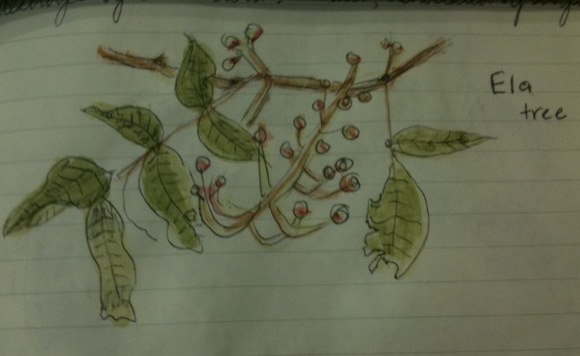
Ela tree with berries; the yellow flowers come later.
It's a very steep climb up stairs and a hillside to the top. The vineyards lie below in the valley of Ela, named for the tree under which we find shade.

At the top of the ridge route is Bethlehem (1 Sam. 17). The Philistines are shooting for Bethlehem as they mass at Sechol and Ephistamin ("lit. no blood). They've probably come from Gath on the coast (Tel Saphe? today). Archaeology ties the Philistine culture to the Mycenaean Greek culture (c. 1900 BC to c. 1100 BC). The battles of the Iliad talk about champion fighting champion as Goliath challenged the Israelites. His bronze leg leggings were also found in Mycenaean armor.

David was already a na'ar or man of valor (late teens, early 20s) when his father sent him to check on his brothers and bring bread and cheese to them and their commanders. He was stuck at home as the youngest in 1 Sam. 16.

The story of David and Goliath story is in 1 Sam. 17. David's older brother Eliab disparaged David. Saul's armor was too tall for David. Interestingly, Judges tells that Benjaminites excelled with slingshots so Saul would have been a natural warrior here. Shepherds learned to wield the weapon with great accuracy to shoot tennis-ball-sized rocks up to 120 meters ... at 100 mph. The sling was an accurate and deadly weapon that crushed Goliath's forehead. David ran up and killed the giant with Goliath's own sword.

David fled from Saul and hid out in the caves of Adulam on the other side of Succoth, in eyesight of his greatest victory with Goliath. Marc encourages students to follow the call of God when they are wondering about life, wallowing in debt or in the middle of crises. "If you are patient and don't get ahead of God, he will lead you. What you think you'll be doing in ten years will likely not be what happens."

In C8 BC, King Hezekiah revolts against the Assyrians. He removes the altars and high places and centralizes worship in Jerusalem, thus elevating the importance of the city throughout Jewish and Christian history every since. He shores up Jerusalem, digging a water tunnel from the eastern side of the city to make water more accessible. He fortified several cities, caught between Egypt and Assyria during the time of the prophecies of Isaiah.

Assyrian records show that Sennacharaib overthrew and devastated Kakish and Azeka, though he did not conquer Jerusalem. Jews became convinced theologically and militarily in the next 100 years that God would not allow enemies to take Jerusalem, so Jeremiah was considered a traitor when he prophesied its demise. Though the cities ruined by the Assyrians were rebuilt, the Babylonians (Nebucadnezar) devastated the area and conquered Jerusalem.

We stop at the bottom of the hill at "David's" creek to gather round stones like David would have used. It's an odd site: two enormous tour busses at the side of the road with 75 people streaming across traffic to gather stones. Once we're on the bus, students begin to question the wisdom of their heavy choices in light of luggage restrictions back home. One gal picks enough stones for each of her youth pastor's kids.

Post along the Roman road
We stop again along the highway to climb a little hill where a section of Roman road remains. Roman roads were likely built on older foundations. Archaeological records of C2 AD are our earliest proofs of Roman engineering skills in road-building to move their armies. The roads facilitated travel, including the spread of the gospel. Acts 8:26ff tells of Philipp and the eunuch of Ethiopia along such a road between Jerusalem to Gaza. One option is the Ela Valley below.

Philip heard the eunuch reading  aloud, which was normal (no silent reading). We admire a mile marker. About 500,000 to one million people lived in C1 Israel. There may have been as many as one scroll per 20 people during the first century; many copies of ancient scrolls have been found.

At Tel Tsafit, we sit under carob trees, eating fresh rolls, peanut butter, jelly, and Israeli Elite (Nutella), Bamba (p-b cheeto snacks), chocolate wafers, and sesame and salty pretzels. Yum. We drink water.

As we get underway, Ilan mentions that the global press mentions Israel's main nuclear base nearby. "Of course, we don't have nuclear weapons," he laughs.

Our next excursion is up a 150 meter hill. The best thing Marc does is not tell us we're going to the top. We climb steps, slip over gravel and sand, and hike huffing and puffing to the peak. Every time we think we're almost there, we look ahead and others are climbing the next ridge. We're at the top of Tel Tsafit, overlooking the Philistine plains to the east with Ashkelon, Ashdod, Ekron, and Gaza in view. Gath is partway up the hill, the home of Goliath. The plaques at the top of the hill point to landmark cities from the C12 BC and beyond.

Phallic symbols (worshipped) and pig bones have been found in the area; the last 10-11 years, archaeologists have been using diet to identify ethnic markers. Jews would not have eaten pork.

The area became the border of Crusaders and Muslims in 12 AD because of its strategic point of view and the fortress, Blanch Garde built on the upper plateau.

We descend on a steeper slope, past chalk caves carved with hieroglyphics and holes carved out for dovecotes. At 3:15 we stop for a potty break, my first since avoiding a smelly latrine with a long lineup at Bet Shemesh this morning. Several tour participants have learned to disappear behind shrubs and rocks on this trip. I have not yet mastered (or tried) that.

We pass Tel Mikre near Ekron. Near Gibeon, Joshua prayed for a longer darkness as he was sneaking his troops from the east to assist the Gibeonites (with whom he had made a treaty) - against 5 kings who were trying to dominate their east-west passage route. It was not a long day but a longer night that he needed for his strategy.  The sun was rising in the east in Gibeon and the moon was descending over the Valley of Ajalon. After using the cloak of darkness, Joshua pursues the five kings across the Ela Valley and kills them in the caves at Adulam. The sun would have been in enemy eyes as they fled.

Knowing the geography assists in correctly understanding the biblical record. "Biblical writers assumed their readers knew the territory," Marc and Ilan repeat to us.

We pass Modi'in, near where Matthias rebelled against forced idolatry imposed by the Greeks and where his son Judas Maccabee, a military genius, began to revolt against the Greek army. About 75,000 people live in the 15 year-old city of Modi'in, placed between Jerusalem and Tel Aviv to allow commuters with young families a high standard of living and safety. Rooftop terraces dot the apartments, and the quality of schools is excellent.

We pass Bet Roh named in the Book of Maccabees. An important fight between the Macabee troops and the Greeks happened on Road 143 where we drive. We're reminded that Benjamin had a small area, but were located near this important junction. The area is now mostly Arabic with olive trees dotting the hills. Many olive presses have been found here.

Traditional terraces are cut into the mountains or held by stone walls. There are two kinds of agriculture in Israel, says Ilan. The first is irrigated, like these terraces, and called Shelach or "sent water." The other kind is non-irrigated, like grain fields and agriculture in the plains, called Baal irrigation to this day.

Continuing in the story of the Maccabean revolt, Ilan tells us that Greeks opened the oil jars in the temple, and only a one-day jar was found to light the temple lamp for the eight days until new olive oil was supplied. The feast of Hanukkah was thus instituted, with the eight-armed menorah and central shamash light.

It's been overcast today with temperature around 27-29oC (mid 89s F), very pleasant. On either side of the highway, the "big ugly wall" or razor wire surrounds West Bank (former Jordanian) territory, the capitol city of Ramallah rising on the nearby hillside. We pass through a checkpoint and are waved by.

Our final stop is Nabi Samuel, a historical marker for the tomb of Samuel, who is actually buried in the eastern crossroad town of Ramah where he lived. 1 Kings 15:16ff shows how people from Jerusalem had to cross the region. The Syrian king Ben Hadad was paid off to capture Judah's cities of Dan and their northern border.

A mosque is built on the site, with separate reading areas for men and women. I go into the women's area, where several mothers and a slough of children are quarantined from the men in the main area.

It's a short 300 meter walk past the mosque to the overlook of the hills and valleys below. Marc says 2/3 of the Old Testament took place within the 360o view. He points out the direction of the city of Jericho, a significant crossroad north and south as well as east and west. Tackling that city gave Israel control of traffic in the region.

Jewish families walk en masse as we head back to the hotel after 5, either coming or going to synagogue. Pentecost is nearly over. The sidewalks teem with black and white outfits, males in suits, women in dresses. We especially are fascinated by the huge fur "lampshade" hats worn by males of one Jerusalem sect.


After supper, both W and I retire. We're exhausted from poor ventilation in the hotel room the past two nights. They fixed it while we were gone today. I have the sniffles and W kept waking last night so we're anticipating a good night's sleep. 

What wakes me is the smell of poorly done laundry: it smells like our bedding was done in a front-loader that wasn't aired. Musty. Not clean. I've learned to go back to sleep but it isn't appealing, nose-wise. (The bedding is beautifully pressed and looks good.) We're up at 5:30 tomorrow morning to be on the bus before our departure at 7am. Whew. Jump into bed already!

Friday, March 2, 2012

Lent Day 9: Thankful for knowing and being known

"Why was David a man after God's own heart?" someone asks. Perhaps because he did not run ahead? Knowing he was to be king, he spared his predecessor twice––during manhunts for his own life.

A group of us circled a beautifully appointed living room last night (thanks, Paul and Bev). Once a month we meet to study Bible characters. Each one exposes God and humanity = God's interaction with us in community and as individuals. Yesterday, David came under the magnifying glass.

We read scripture passages aloud and then discuss the nature of God, the nature of humans, and our response to God within the joys and challenges of our own humanity. On the way home, W and I talked about what we had learned.
  • My personal takeaway? Creating opportunity for others to understand God's truths makes me happier than when I learn things myself. Clear as a bell, my heart rang out with the pure joy and energy of leading a group. 
  • Training and teaching others feels like finding a puzzle piece or watching internal gears click into place. A sense of ease and comfort comes from facilitating the exploration and application of scripture. This is not something I struggle to learn or do but who I am. I'm surprised by sheer happiness every time I speak in public.
  • What we learned about Samuel and David? Samuel, the veteran leader and intercessor of Israel, was stuck. The worst thing had happened to his successor: Saul was a dud. Yet God was ready to move on and provided Samuel with the satisfaction of anointing the next generation.
  • David had tremendous self-confidence because he knew his God and himself. He was comfortable in the gifts God gave him, a love of music, the ability to strategize, the confidence to run toward a giant who was defying God's name. When given an opportunity, David seized it and did the job with gusto (unlike Saul whose lack of self-confidence never matched up to his kingly appearance.)
  • David did menial jobs with enthusiasm and never pushed himself into the foreground. Knowing he would be king and having accomplished champion feats, David willingly stood in the background of the palace, playing music and lugging armor while Saul ruled. (I wonder how many of David's ideas for sound monarchy came from observation: "Wow, good plan there!" or the contrast: "Saul, what are you thinking!? This is a bad idea." 1 Samuel 16)
  • As the youngest brother, he got no respect from his dad, who didn't even call him to dinner with Samuel. (Read the full story below.) His older siblings discounted him––even after they had watched Samuel anoint David for kingship (shades of Joseph?) David's feisty response of "What have I done wrong now?!" possibly exposes a pattern of family put-downs and "Go away, little brother, you don't know anything." (1 Samuel 17)
  • David used his own gifts, training, and experiences rather than relying on the proven armor and battle plans of others. He laid aside the burden of Saul's armor (though he had been an armor bearer for the king and probably knew it well) for smooth stones and a stick, tools he felt comfortable with.
  • David pinpointed the heart of the issue rather than looking at circumstances. He recognized Goliath as God's enemy, not as a human giant or seasoned opponent and dealt with him on that basis. The fight as well as the victory belonged to God. However, David did not let go of Goliath's severed head until he was taken to the king as proof of his accomplishment. Hmmm.
  • David had many opportunities to make God's plans come true but he was unwilling to act beyond what he knew of God's character. Because of this, he and those allied with him suffered while: 1. others got credit and lived in the inner circle; 2. David was hunted like an animal and led a rabble pack of raiders; and 3. he absolutely rejected chances to seize power through "divine appointments," even when prompted by others.
Maybe David's patient humility, decidedly unusual among those in power or the ambitious, endeared him to God. Though David committed adultery, murder, and disobeyed God in many ways, God saw a heart that longed for obedience and surrender.

When Samuel came to anoint one of Jesse's sons as future king, he noted that God looked on the inner person rather than the outward appearance. David's quest to please God and his willingness to let God work out the details in God's time set him head and shoulders above seven brothers. It made the shepherd "of a few sheep" (according to a snide remark from his brother) an amazing leader of a nation.

I'm ending a season of study. I get many suggestions of what I could do and where God might be leading me. The study of David reinforced my caution against moving forward and making things happen. I'm going to wait for God's go-ahead and a clear call to action.

Oh God, may we seek and obey you with the humble confidence that knows you are pleased with how you made us and have a place for us. You are able to use us without our "help" in pushing others aside, propelling ourselves forward, or boasting about our accomplishments. 

Make us beautiful inside so that your Spirit can direct us in life's menial and circuitous paths as needed, whether kingship or sheep herder is our destiny. Amen.

Read more:
*The LORD said to Samuel, “How long will you mourn for Saul, since I have rejected him as king over Israel? Fill your horn with oil and be on your way; I am sending you to Jesse of Bethlehem. I have chosen one of his sons to be king.”

But Samuel said, “How can I go? If Saul hears about it, he will kill me.”

The LORD said, “Take a heifer with you and say, ‘I have come to sacrifice to the LORD.’ 3 Invite Jesse to the sacrifice, and I will show you what to do. You are to anoint for me the one I indicate.”

Samuel did what the LORD said. When he arrived at Bethlehem, the elders of the town trembled when they met him. They asked, “Do you come in peace?”Samuel replied, “Yes, in peace; I have come to sacrifice to the LORD. Consecrate yourselves and come to the sacrifice with me.”

Then he consecrated Jesse and his sons and invited them to the sacrifice. When they arrived, Samuel saw Eliab and thought, “Surely the LORD’s anointed stands here before the LORD.”

But the LORD said to Samuel, “Do not consider his appearance or his height, for I have rejected him. The LORD does not look at the things people look at. People look at the outward appearance, but the LORD looks at the heart.”

Then Jesse called Abinadab and had him pass in front of Samuel. But Samuel said, “The LORD has not chosen this one either.” Jesse then had Shammah pass by, but Samuel said, “Nor has the LORD chosen this one.” Jesse had seven of his sons pass before Samuel, but Samuel said to him, “The LORD has not chosen these.” So he asked Jesse, “Are these all the sons you have?”

“There is still the youngest,” Jesse answered. “He is tending the sheep.”

Samuel said, “Send for him; we will not sit down until he arrives.” So he sent for him and had him brought in. He was glowing with health and had a fine appearance and handsome features.

Then the LORD said, “Rise and anoint him; this is the one.” So Samuel took the horn of oil and anointed him in the presence of his brothers, and from that day on the Spirit of the LORD came powerfully upon David. 1 Samuel 16

*Read more about David in 1 Samuel 17 through 2 Samuel 2.

Monday, November 28, 2011

In with the Old...

In with the Old Testament, that is. I listen to the Bible on radio a few times a day. 

I find the Old Testament really depressing. It's not that God is unfaithful or uncaring. It's that we are such stupid people, generation after generation. (I'm not using the term "stupid" lightly, either.) 

From the time the first people began to reason, we think we know better than God. Adam and Eve choose "the knowledge of good and evil" over knowing God and the wonderful surprises he had planned in his relationship with them. By the time Noah is told to build the ark, humanity is so corrupt that God chooses to start over with Noah and his family. Researches note that Noah would have had to take about 3,800 species into the ark to keep diversity as we see it today; everyone and everything could have fit into his boat as long as Noah saved the lower tier for manure. Ugh stinky. But after all that work, one of his grown sons is disrespectful and consigned to serve everyone else. The writer of Genesis doesn't say if Noah had a temper, but his curse on his son sure sounds like it.

Then Moses, the murderer, impulsive caretaker, and meekest person on the planet. Gideon, who keeps making excuses why he shouldn't lead and builds an idol from the spoils of God's victory. Rehaboham, Solomon's heir, who splits the kingdom by being a tyrant. Israel, who goes "whoring after other gods" time and time again... 

It's just depressing. Some people find the OT uplifting because of God's faithfulness. I think that's the only good part of the story. People who are faithful to God get thumped by their peers. They're told they are out of step and idiots to serve God. Evildoers hunt them down and kill them when possible. Much of the Old Testament contains God's warnings of the horrible punishments his righteous judgment will inflict. Does anyone pay attention? Very few do. Very few indeed.

It gives me a heavy stomach to read the stories. I find myself stopping and losing track between all the prostitution, killing, and idolatry. Which is why I have scripture read to me on UCB Bible. I can focus on the words, the scope, the ongoing movement of God among us through history.

I don't understand most of what the Bible says about God. He is like the wind whose movement is seen and felt but cannot itself be captured. The more I know, the less wisdom and understanding I seem to have. The older I get and the deeper into a life of faith, the more trust it takes to pray, "Not my will but yours for this day." I want to shout, every time I see horrible things on the news, experience another surgery alongside my daughter who lives in pain, or hear of marriages breaking up, financial ruin, and people taking advantage of others-- "PEOPLE PAY ATTENTION! DON'T BE SUCH MORONS!!! GOD WHERE ARE YOU?!!"

But would anyone mind a warning? I'd probably be sent away to an asylum for disturbing the peace, if not for appealing to God for help.

Yet I also sin. Continually. I break the law and cut into line, looking out for myself rather than my neighbor. I look without pity on the poor and needy and walk by those who need my help, the Pharisee hastening on the other side of the road so I don't become "defiled" or waste precious time (Luke 10:25-36). 

Grrrr. After all these years of reflection and saying to God, "I'm yours. Help me to obey. Help me to love you with all my heart," I'm still a sinner, continually washed by God's grace and a once-for-all blood sacrifice.

I am comforted by reading the stories of Abraham (liar, coward, God's chosen) and David (adulterer, murderer, deceiver - pretend-madman, God's chosen). Both kept coming back to say, "Sorry! I'm actually and truly yours, in spite of what I just did. Please help! No other gods before you."

The God who had mercy on them looks on me with pity and compassion, too. "Lord have mercy! Christ have mercy! Lord have mercy!"

I'm praying with the Orthodox church today, after listening to a half hour of genealogies from 1 Chronicles. Oh please - how about some cheerful psalms? Like #150. 

Read more:
The LORD is gracious and full of compassion, slow to anger and great in mercy. The LORD is good to all, and His tender mercies are over all His works. Psalm 145:8-9 NKJV 

Thanks be to God.

Thursday, March 3, 2011

Leadership genius


King David's name is familiar to anyone who has read the Bible. Kids who know Bible stories have heard of the teenager who felled a seasoned warrior - a giant at that - with a well-placed stone flying from his sling.

Off the top of my head, I think of David as:
  • shepherd boy, defending the flock from lion and bear
  • killer of Goliath, with a faith that is both bold and innocent
  • younger brother of soldiers, eager to get the scoop on battlefront news
  • musician and composer, harpist, singer, poet, and dancer
  • leader of a rebels, living on the run in the hills
  • replacement for a disobedient king
  • polygamist and adulterer
  • schemer and strategist
  • someone who came from a simple life to extravagance and leadership perks
I am always surprised to read that God considered this flawed man his friend. We'd never elect him to a church board or (horror of horrors) let him pastor a church or lead a denomination. He wasn't of the priestly class in his day, either. He was a warrior of his time, accepting as his due the privileges of clan chief - the right to servants, wives, and wealth. Because David's reign was so bloody, God refused him his desire to build a temple.

Something I rarely connect with David is his genius for leadership. He had the charisma and skill to attract rough outcasts into a band of brothers, complete with families and belongings. Later, he united tribes with little in common into a strong nation.

Reading 1 Chronicles 23-27 is eye-opening. Near the end of  David's reign, the details of the king's wealth are impressive. But my eye is caught by the men listed as overseers. These "mighty men" and strong-willed, gifted leaders reported to the king and did the king's business. Even when his personal life became a mess, when his children were indulged and spoiled, when political turmoil ousted him for a season, the administration of his dominion ran like clockwork.

It's easy to assume that God is blessing a ministry or business when it's running smoothly and money is flowing. Inexplicably, God gifts some for leadership of tens, hundreds, thousands, and beyond.


When God blesses with leadership genius, the person must work extremely hard to stay centered on the core values of integrity and friendship with God. Without character, success goes to one's head, destroying a gifted leader with a wash of self-indulgence and dissipation.

W and I were talking about how hard it is to finish a life well. It seems even more challenging for those who start gloriously and achieve a lot early on.

A good name is more valuable than riches, said the sage. It's a good idea to guard our hearts and reputations even more zealously in seasons of success than in times of anonymity or struggle. 

Read more:
*Blessed is the man who does not walk in the counsel of the wicked or stand in the way of sinners or sit in the seat of mockers. But his delight is in the law of the LORD, and on his law he meditates day and night.

He is like a tree planted by streams of water, which yields its fruit in season and whose leaf does not wither. Whatever he does prospers. Psalm 1:1-3 NIV

*Better is the end of a thing than its beginning, and the patient in spirit is better than the proud in spirit. Ecclesiastes 7:8 NLT

*What shall we say, then? Shall we go on sinning so that grace may increase? By no means! We died to sin; how can we live in it any longer? Or don't you know that all of us who were baptized into Christ Jesus were baptized into his death? We were therefore buried with him through baptism into death in order that, just as Christ was raised from the dead through the glory of the Father, we too may live a new life. Romans 6:1-4 NIV