Disclaimer: my blog contains personal observations and the opinions, typos, and errors are mine alone. (The guides and tour leaders know their stuff.)
It's the last full day of the tour. Tomorrow we'll have a free day before we fly home from Israel.
 |
Monument to the Jewish Soldiers and Partisans who
Fought Against Nazi Germany (B. Fink) |
We read Ephesians 1, on the bus at 7:40 am. Our first stop is Yad Vashem. I'm apprehensive how I'll do: I can hardly read the Passion accounts of Christ's trial and death - too awful. The museum guides are late, so I have time to wander the grounds and sketch a 20' metal and granite monument by Bernard Fink.
Yad = memorial; Shem = name. This is a place where the names of the dead are remembered and the heroic efforts of the "righteous among the nations," people who saved Jews during WWII, are memorialized. The "righteous" are granted Israeli citizenship. Israel prefers "Shoah" (unimaginable catastrophe) to "Holocaust" (the Greek word describing a sacrifice to a pagan god.)
A tour guide races us through the museum. I'm usually at the back and can't see what she's pointing to so have to lag to view the exhibits. There's no time to absorb what we are seeing, a systematic desensitizing of German children and adults to the humanity of Jews. By the time the children grow into young people, they have little conscience about treating Jews like animals ... or worse. The building's concrete represents the ugly scar on the Jewish psyche. We go from carpet (the comforts of home) to hard cement floors, from large open spaces to places we have to squeeze through, representing the removal of Jews from normal comforts to unimaginable horrors and deprivation.
The guide says the museum is full of choices made - and that while it is easy in retrospect to tell how choices should have been made, at the time, rabbis, German soldiers, church officials, and others made choices that hurt or helped Jews. Few escaped the hatred of Hitler's culture: in Poland, comprised over over 10% of Jews before the war, most of the population was wiped out in concentration camps or - as in other parts of Europe - by locals who hated them. Anti-semitism was wide-spread throughout the Roman Catholic and Protestant churches. Hitler quoted Martin Luther's rampages against Jews and other "christian writings".
The healthiest were sent to labor camps where they worked for Daimler-Benz, Siemens, and other German firms as slaves. The weaker ones were gassed at concentration camps, sometimes 2000 at a time at Auschwitz where German efficiency reached a demonic fervor, or otherwise murdered.
The facts roll around but the sheer scope of the massacre is too much to process. If it were not for the C19 American treatment of African-American slaves, the eastern European debacle in Serbia, and recent Muslim killings in Nigeria, it would be incomprehensible for me. As the tour guide says, "What would I do if confronted with the choice to help Jews under threat of my family's life? Would I have the courage to save the life of a stranger if it put my own family in danger?" She gives several illustrations of those who risked everything, including some who lost their own lives to do it.
One of the things Ilan and Marc said earlier in the tour was that God gave the Law to the Jewish nation to demonstrate right and wrong among all the nations. "Once again," I think, "Once again, by remembering what was done to them, Jews become the conscience of the world. They stand together as a moral voice to the nations to say, humanity is made in God's image so every person has value. We show mercy and never forget how terrible we can be to each other."
I am breathless with grief and pain when we sit down to listen to a concentration camp survivor. Ashel Ud wraps up the morning by telling the story of how he - an 11 year old boy - was trapped in the dehumanization of Jews. He survived the camps and was sent to Italy and then Israel, where he was educated and worked. "I have never told the story to my children because I would break down with the first sentence," he said. "But I tell it to you so that you can say you have met someone who was there. Don't forget me, no matter who tells you that the Shoah was a fabrication. I was there. It happened. It happened to me." He shows us the camp # tattooed on his forearm.
His brother, who also survived through a remarkable series of circumstances, was adopted by non-Jews, married, and - like many other survivors - had never told his family he was Jewish. In later life, he and his brother became reconciled; he and his family now live in Israel as well. I may write more details of this morning at a later date. Tonight my heart is too shattered.
We exit the museum to a sunny hillside view. It's 34oC (92oF) outside when we head into the Old City. Marc talks about the Anti-Semitism in New Testament studies today. "You have no excuse. You have seen what happened today and it is your responsibility to help prevent another Shoah in the future."
Shimon negotiates the narrow streets of Arabic Jerusalem. There is lots of garbage on the street and in the yards. On the top of the Mount of Olives, an older man with crutches offers us camel rides. When we walk by with "No thank you"s, he mutters, "Americans hate Arabs!"
 |
| Sculptural arch in the Dominus Flevia |
The 200o view below includes Jerusalem, Herodium, Nebi Samuel, and the Mount of Olives. We descend to the Sanctuary of Dominus Flevis (Lord's Tears). There's a C1 AD tomb with ossuaries (bone boxes) broken open. This style of burial - laying out the body for a year to leave only the bones, gathering the bones into a box, and sharing the box between several bodies lasted about a hundred years, around the turn of BC to AD. The church is beautiful with soaring arches above us. We sing into the arches.
Marc discusses the concept of older and younger brother and Jesus' comment regarding "Let him who is the greatest (eldest) become like the younger" in the context of Jacob and Esau. The Hebrew construction of God's information to Rebekah can be interpreted either as "The younger will serve the older," or "the older will serve the younger." Israel understood that if they did not do the will of God, they would serve. Edom (Esau)'s motto was "Might makes right," but God's people were to choose a different path. Jesus, in the middle of sectarian stirrings to move God to action through violence, warns that God's way is not violence or power plays.
"We also need to remember that we are not called to grow big churches," Marc cautions. "We are called to obedience, to follow God by showing mercy to others. We obey. God makes things happen. Jesus' final plea was that his disciples become servants. Scriptures only tells us to pray for the peace of once city, the microcosm of the world - Jerusalem. Here were have religious intolerance, ethnic clashes, etc. If we pray for the peace of Jerusalem, we pray for all nations."
 |
Metal thorn railing around the stone altar:
Church of all Nations |
In the Church of All Nations, the beauty and tranquility of space is set aside for reflection. We pause for a while to reflect on the accomplishments of Christ. The church is in the traditional site of the Garden of Gethsemane, now a pretty garden with 1700-year-old olive trees. "These are not the trees under which Jesus prayed, but perhaps they are children of those trees," we are told.
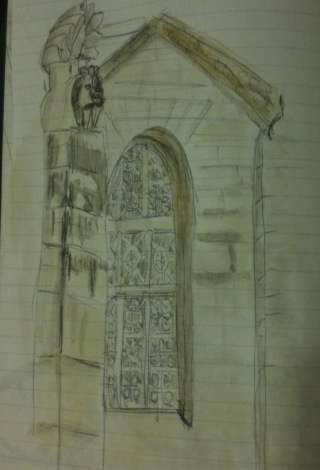
The outside windows are beautiful, too. I draw a little section of the wall.
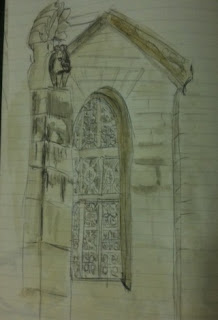 |
Windows outside the Church
of All Nations |
We enter through the Lion's Gate. Al-Sulami the Ottoman had a dream where he saw lions prowling around Jerusalem and built up the city walls.
We hike up the hill to the Old City, steep in the hot sun. "Drink more water!" says Ilan. "It's a discipline. You have to drink water." We pull out our water bottles and chug away.
We pass through a quiet garden with flowers, birds chirping, and date palms rustling overhead. It is the purported birthplace of the Virgin Mary. Nearby is the most ancient intact church of the Crusader era in Israel, the Church of St. Anne. Muslims turned it into a school and then piled it with junk, so it was not destroyed in their purges of Christian sties. It was purchased by the African White Fathers and is well-maintained.
Liturgy was sung rather than spoken in St. Anne's. Three students lead in songs. Their generation doesn't know many hymns, usually the first verse of a popular few. And their choruses are difficult to sing without a band and drums. But they lead us well in a time of worship and adoration. The music rolls around the stone walls, pillars, arches, and resounds back to us off the ceiling.
The church sits next to crumbling excavations of the pools of Bethesda. The cisterns in the center held water from Roman aquaducts, but side pools might have been places for healing waters. In this location, we are told that Jesus healed a lame man, according to John 5.
We walk the traditional Via Dolorosa (Way of Suffering) that dates back to Crusader times. Why did this become the route, when it's obvious from archaeology that it's not correct? "Europeans had their shops here, so it was a natural path to travel." There are still shops on both sides of the Via Dolorosa today. Our destination is the roof of the Church of the Holy Sepulcher. While we sit in the shade, Marc teaches us about the excruciating physical nature of crucifixion. "In your hands I commit my spirit" was on the lips of every dying righteous Jew.
 |
Stone carving on a roof wall
Church of the Holy Sepulcher |
We have to race through the Church of the Ascension (Holy Sepulcher). I'm glad W and I saw it last week. Several stations are closed for mass in the Orthodox section. When we emerge, Marc talks about the responsibility of the tour participants. "God has brought you here to make you witnesses. Your testimony from here on is predicated on reality. Jesus was not just a story or idea. He was God's son, sent as a living person in this region." He urges us to continue further study and exploration of our faith.
Our last stop is the Western Wall. Men and women separate to pray at the wall. It is the area closest to where the Temple stood and still a working synagogue. Jews belief the Presence of God was never removed from the wall. It is the physical center of their prayers. Messengers began to put notes into the wall for those who could not come themselves; the tradition has grown to where people place prayers in the cracks between the stones of the wall.
Hundreds of women stand in the smaller space. They are reading scriptures, rocking, sitting in chairs, or touching the wall. A bookshelf with Hebrew scriptures leans near the entry. A bride in full white dress and bouquet comes to pray. She leans her head against the wall near the men's fenced area. A male hand holding a video camera reaches over the wall to record her prayers as she looks his way and poses. She's tall. She looks across the wall for someone she knows before returning to pray and then walk away, train dragging across the stone floor, flowers in hand.
We wait for our busses outside the Dung Gate. I get a chance to say thanks to Avi, a superb tour guide on the other bus. He was SO helpful in identifying customs and plants and cultural items when Ilan was elsewhere.
 |
Jeff's card: pencil rubbing of pilgrim graffiti in
the stairwell of the Church of the Holy Sepulcher
(red cross and edging for our Red Bus) |
Before we drop Ilan off, W presents three cards on behalf of Red Bus riders: to Jeff - with a Moleskin notebook to record future adventures (our bus' prof and scholar), Ilan - with a few chocolates (excellent Israeli tour guide), and Shimon - with a portrait of his face in the rearview mirror (great bus driver). We cheer them on for their good work. On the other bus, Vanguard's Carolyn Degelman does the same for her driver Allah and tour guide Avi.
Last week at the Church of the Ascension, I made a few pencil rubbings over the carvings in the stone walls. I painted small red and blue borders as appropriate to each bus to make thank-you cards. We passed them around the two busses last week and hopefully everyone had time to sign them. I'd collect them in the evenings so they didn't get rumpled or lost.
Back at the hotel, we rush through supper and use a black Sharpee to identify "Amy Turnage's Portable Laundry" on W's dry bag. He passes it along so she can do her laundry for the rest of the trip.
Then it's time for the final evening session. Marc and Jeff are at a meeting in town. Amy gives us instructions on traveling back home. W presents her with the card signed by both busses. We cheer her wonderful kids for their hospitable come-along spirits.